

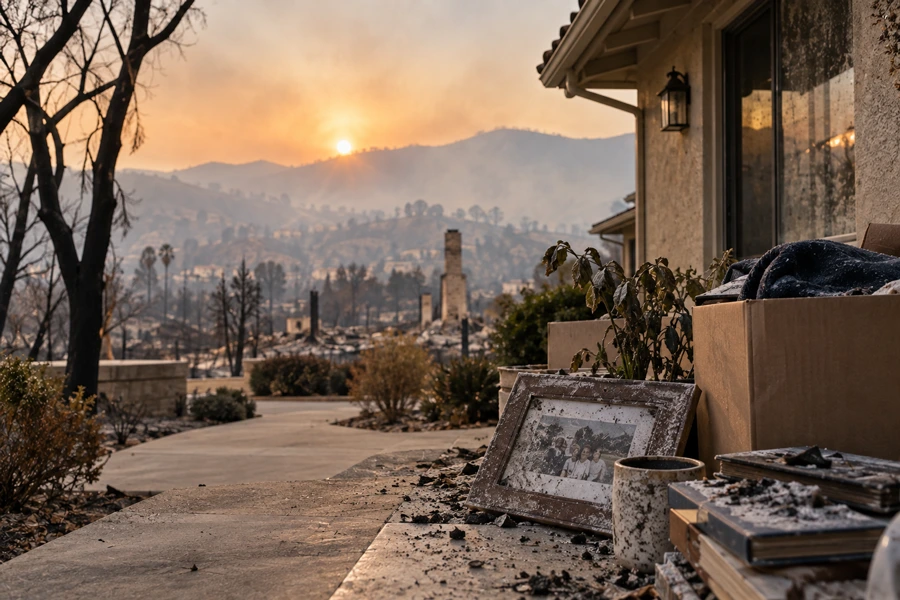
The houses that burned to the ground are the ones on the news. The larger group of people — the ones still living in a home that smells like a campfire eight months later, arguing with an adjuster about whether ash counts as damage — get very little attention and very little help.
Both situations are insurance claims. Both are frequently underpaid. Here is what to know.
Smoke and ash damage is real damage
The most common wildfire coverage dispute in Southern California has nothing to do with flames. It is whether smoke, soot, and ash infiltration constitute a covered direct physical loss.
Insurers routinely take the position that a home that did not burn can be handled with a professional cleaning. That position is often wrong. Wildfire smoke residue is chemically different from ordinary household soot — it carries combustion byproducts from burned structures, vehicles, plastics, and treated materials. It penetrates HVAC systems, attic insulation, wall cavities, upholstery, carpet padding, clothing, and porous building materials. Surface wiping does not remove it, and a “clean” visual inspection proves very little.
If you are being told your home is fine and you can smell it, or your family has developed persistent respiratory symptoms since the fire, get independent testing from an industrial hygienist. Test results are the difference between an argument and evidence.
Additional living expenses
ALE — sometimes called Loss of Use — covers the increased cost of living somewhere else while your home is uninhabitable. Rent, hotels, storage, pet boarding, additional commuting costs, and the increased cost of meals.
Two things people do not know:
First, “uninhabitable” is not limited to a home that burned. A standing home with smoke contamination, no power, no water, or no safe access can qualify.
Second, California has enacted specific ALE protections for losses in a declared state of emergency, requiring coverage well beyond the standard policy period and providing for extensions. Post-2025, this area of the Insurance Code has been amended repeatedly and the applicable periods depend on your date of loss. If your carrier has told you your ALE is exhausted, that determination is worth verifying against the current statute rather than accepting.
The contents inventory nobody can face
After a total loss, insurers ask for an itemized inventory of every item in the home, with age, original cost, and replacement cost. For a family that lost everything, this is a genuinely brutal request — and it is where enormous amounts of money are lost, because exhausted people give up partway through and accept a percentage.
Approaches that help: work room by room from memory and old photographs; pull years of email receipts and credit card statements; ask family and friends for photos taken inside your home; check social media posts that captured rooms in the background. Insurers are also permitted, and frequently willing, to advance a percentage of contents coverage without a completed inventory. Ask for it.
Underinsurance
Most fire victims discover only after the loss that their dwelling coverage will not rebuild their home. Construction costs in Southern California have risen faster than policy limits were adjusted, and post-disaster demand surge pushes them higher still.
Where a policy limit falls dramatically short, the question becomes how that limit was set. If an agent or broker calculated the replacement cost, represented the coverage as sufficient, or used a valuation tool that produced an unrealistic figure, there may be a claim against the agent or brokerage separate from the claim against the carrier. Extended replacement cost, building code upgrade coverage, and debris removal coverage are also frequently overlooked line items that add real money to a claim.
Rebuilding timelines
California law gives policyholders a minimum period to actually rebuild and still collect full replacement cost benefits, with substantially extended periods following a declared disaster. Permitting delays, contractor shortages, and utility restoration make those extensions essential. Do not assume the deadline printed in your policy is the one that governs — statutory minimums override shorter policy terms, and extensions are available on request. Ask in writing, and keep the response.
Claims beyond your own insurer
Where a wildfire was caused by utility equipment, claims may lie directly against the utility. California’s inverse condemnation doctrine can impose liability on a utility for damage caused by its infrastructure without requiring proof of negligence, and negligence claims may be pursued alongside it.
These claims are separate from your insurance claim and are not eliminated by receiving insurance benefits — although your insurer will assert a subrogation interest in what it paid. Importantly, these claims can cover losses your policy does not, including uninsured losses, the shortfall on an underinsured home, emotional distress, and in some circumstances the diminished value of land.
Deadlines for these claims differ from insurance deadlines, and settlement funds and trusts established for particular fires impose their own filing windows. If you have been affected by a Southern California fire, find out which windows apply to you rather than assuming your insurance claim is the whole picture.
Two deadlines to calendar today
The suit limitation in your policy. Most California property policies require suit within one year of the date of loss, tolled during the insurer’s investigation. Statutory extensions apply to certain declared-disaster losses. This period runs regardless of how cooperative your adjuster seems.
Claims against third parties. Generally three years for property damage, two years for personal injury, and as little as six months where a public entity is involved.
Tax treatment of what you receive
Fire recoveries have tax consequences that are worth handling before year-end rather than after. Insurance proceeds exceeding your basis in the property can generate gain, though involuntary conversion rules generally allow deferral where proceeds are reinvested in replacement property within the applicable period. Casualty loss deductions have special rules in federally declared disaster areas. Federal legislation has also addressed the treatment of qualified wildfire relief payments, and the applicable window matters.
Because our firm handles both property damage litigation and tax matters in-house, these questions can be addressed together rather than discovered in April.
If you are still fighting your carrier
We handle fire and wildfire damage, smoke and ash damage, and the underinsurance and bad faith claims that follow. If your claim has been denied, delayed, closed prematurely, or paid at a number that will not rebuild what you lost, the file is worth a second look.
Kamarian Law, Inc.
210 N Glenoaks Blvd, Suite D, Burbank, CA 91502
818.859.7090 · info@kamarianlaw.com
Southern California Fires: Rebuilding Our Community · Property damage practice · Schedule a consultation
This article is provided for general informational purposes only and does not constitute legal or tax advice. Reading it does not create an attorney-client relationship with Kamarian Law, Inc. Insurance statutes governing wildfire claims, additional living expenses, and rebuilding periods have been amended frequently, and the provisions applicable to your claim depend on your date of loss and policy terms. Prior results do not guarantee a similar outcome. Consult a licensed attorney about your specific claim.