

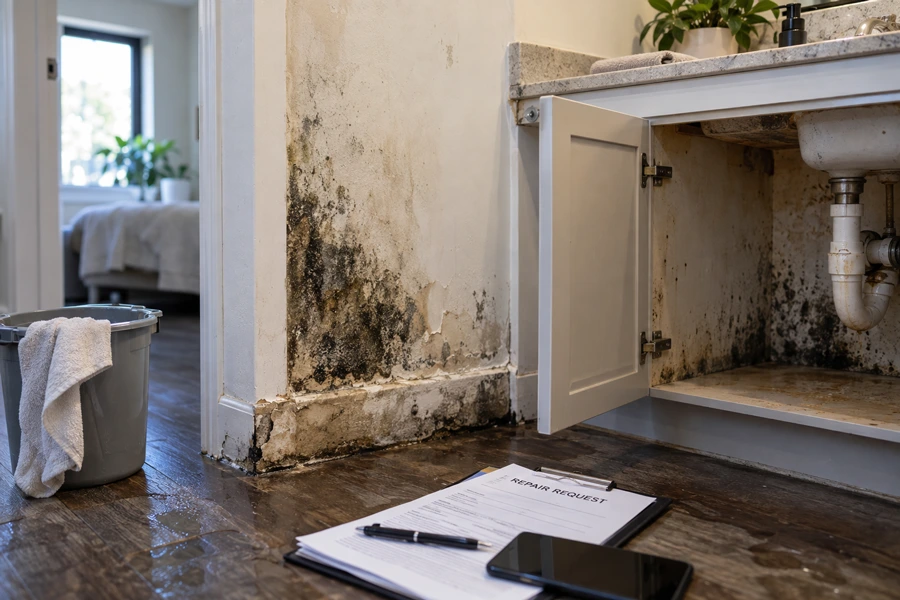
You reported the leak in March. It is now September, the drywall is soft, there is black growth spreading behind the vanity, and your landlord’s last text said someone would come by “next week.” Meanwhile you are paying full rent for a home that is making your family sick.
California law does not treat this as bad luck. It treats it as a breach of a promise your landlord made the day you signed the lease.
The implied warranty of habitability
Every residential lease in California contains an implied warranty of habitability. It cannot be waived, and it does not matter what the lease says. Your landlord is obligated to maintain the unit in a livable condition for the entire tenancy — not just on move-in day.
Civil Code § 1941.1 defines what makes a dwelling untenantable. A unit generally falls below the standard if it lacks:
- Effective waterproofing and weather protection of roof, walls, windows, and doors
- Working plumbing and gas facilities in good repair
- A water supply with hot and cold running water and proper connection to a sewage system
- Adequate heating in good working order
- Safe and functioning electrical lighting and wiring
- Grounds and common areas kept clean, sanitary, and free of debris, garbage, rodents, and vermin
- Adequate trash receptacles
- Floors, stairways, and railings maintained in good repair
- Working deadbolt locks on main entry doors and functioning window security devices
- Operable smoke and carbon monoxide detectors
Health & Safety Code § 17920.3 goes further, listing conditions that render a building legally substandard — including visible mold growth that endangers health, infestations of insects or rodents, defective sanitation, dampness of habitable rooms, and structural hazards.
Mold specifically
Mold is where landlords most often insist nothing is legally wrong. It is worth understanding the actual state of the law.
California passed the Toxic Mold Protection Act in 2001, which contemplated the state adopting permissible exposure limits for indoor mold. Those limits were never adopted. Landlords sometimes cite this as though it means mold claims cannot be brought. It means no such thing.
Visible mold growth is expressly identified as a substandard condition under the Health & Safety Code where it endangers the health of occupants. And the underlying cause is almost always independently actionable on its own: the roof leak, the plumbing failure, the missing bathroom ventilation, the moisture intrusion the landlord was told about months ago. You do not need a statutory exposure limit to prove that water was allowed to sit inside a wall for a year.
What you can recover
Habitability cases are not limited to a rent refund. Depending on the facts, tenants may pursue:
- Rent abatement — the difference between what you paid and what the unit was actually worth in its defective condition, often calculated over the entire period of the violation
- Out-of-pocket costs — damaged furniture, clothing, electronics, temporary lodging, air purifiers, medical expenses
- Emotional distress damages, which California courts have permitted in habitability cases
- Statutory penalties under Civil Code § 1942.4, which bars a landlord from collecting rent where a cited condition remains unrepaired after the required notice period, and allows for actual damages plus a statutory penalty and attorney’s fees
- Punitive damages where the landlord’s conduct rises to oppression, fraud, or malice — which a long, documented history of ignored complaints can support
- Attorney’s fees, available under several statutes and under many lease provisions
Repair and deduct, and its limits
Civil Code § 1942 allows a tenant to make repairs and deduct the cost from rent — but the limits are real. The deduction generally cannot exceed one month’s rent, and the remedy can be used no more than twice in any 12-month period. You must have given the landlord notice and a reasonable time to fix the problem first.
For a $400 plumbing repair, this works. For remediating mold behind three walls, it does not come close. Do not rely on it for serious conditions, and do not simply stop paying rent without legal advice — rent withholding done incorrectly is how tenants end up defending an unlawful detainer.
If your landlord retaliates
Civil Code § 1942.5 prohibits retaliation against tenants who complain about habitability. If a landlord raises your rent, cuts services, or moves to evict within 180 days of your complaint to the landlord or a public agency, the law presumes retaliation and shifts the burden to the landlord to prove otherwise.
Retaliation claims carry their own damages, including punitive damages and attorney’s fees. A retaliatory eviction filed after a documented complaint often strengthens a tenant’s position rather than weakening it.
Unpermitted and illegal units
A significant number of Southern California rentals are converted garages, basements, and additions built without permits. These units frequently lack legal ceiling height, egress windows, ventilation, or proper electrical and plumbing. Tenants in unpermitted units may have claims for the rent paid on an illegal dwelling, in addition to habitability claims — and landlords who rented them out knowing they were unpermitted face meaningful exposure.
Build your record now
- Put every request in writing. Text and email are fine and are better than phone calls, because they are time-stamped. If you have only called, send a follow-up email summarizing the call.
- Photograph and video conditions repeatedly over time. A single photo shows a stain. A series across six months shows a landlord who knew.
- Keep every response, including the ones promising repairs that never came.
- Call code enforcement or your local health department. An official inspection report is powerful evidence and triggers the § 1942.4 timeline.
- See a doctor if you or your children have developed respiratory symptoms, rashes, or persistent illness, and tell the provider about the housing conditions so it goes in the chart.
- Save your rent payment records. Abatement is calculated against what you paid.
- Do not move out abruptly without advice. You may have options that preserve your claim, and constructive eviction has specific requirements.
We take these cases against landlords who won’t act
Toxic mold exposure. Rodent and pest infestations. Bed bugs. Illegal and unpermitted ADUs. Plumbing and sanitation failures. Illegally collected rent and lease violations. Other unsafe conditions caused by deferred maintenance.
Case reviews are free and confidential. Nothing you tell us gets back to your landlord.
Kamarian Law, Inc.
210 N Glenoaks Blvd, Suite D, Burbank, CA 91502
818.859.7090 · info@kamarianlaw.com
Learn more about our habitability practice · Schedule a consultation
This article is provided for general informational purposes only and does not constitute legal advice. Reading it does not create an attorney-client relationship with Kamarian Law, Inc. Local ordinances in Los Angeles and surrounding cities may provide additional protections beyond state law. Laws change and every case turns on its own facts. Prior results do not guarantee a similar outcome. Consult a licensed attorney before withholding rent or terminating a tenancy.